Five-year follow-up on risk factors for condylar resorption after maxillomandibular advancement surgery
Authors
- Nielsen TW, Holte MB, Berg-Beckhoff G, Ingerslev J, Thorn JJ, Pinholt EM

Abstract
Objectives
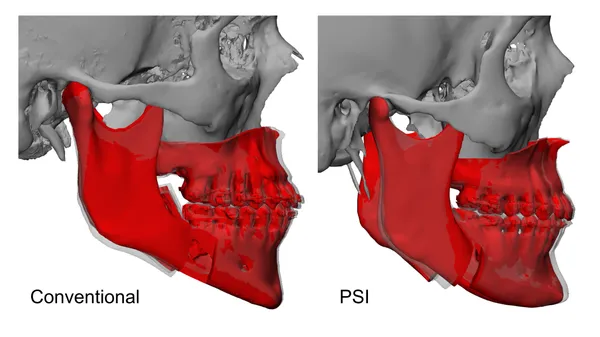
Limited long-term three-dimensional (3D) studies exist evaluating risk factors for condylar resorption following orthognathic surgery. The aim was to evaluate patient demographics, -clinical and -radiographic characteristics as well as orthognathic surgical effects on long-term postoperative condyle volume, -height and horizontal skeletal stability using a 3D approach.
Methods
Analysis of clinical data and cone-beam computed tomography presurgery, approximately 2 weeks and 5 years postsurgery was carried out on 50 subjects (17 males, 33 females), mean age 25.62. Multiple significant prediction factors for horizontal skeletal relapse, condylar volume and -height loss were identified, which combined are indicative of progressive condylar resorption.
Results
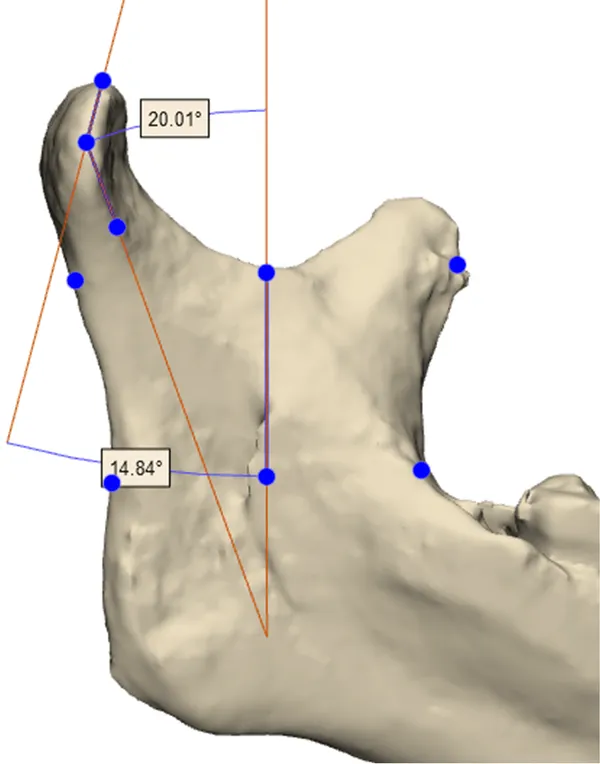
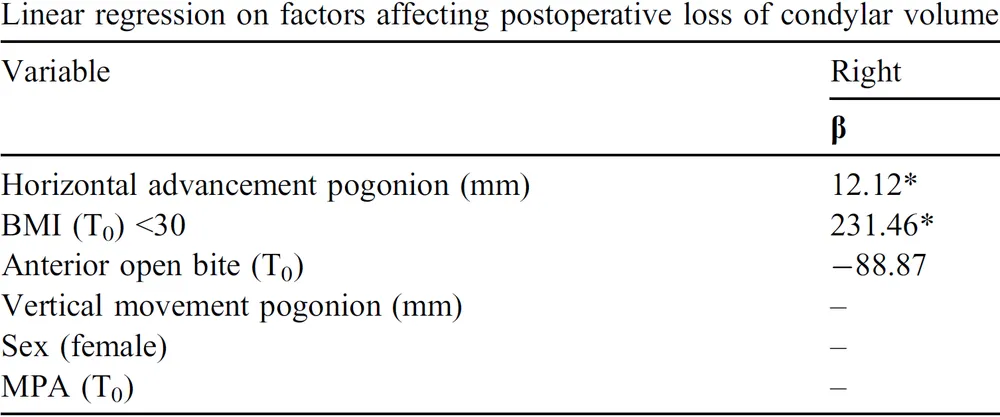
The magnitude of mandibular advancement, -vertical movement, and preoperative Body Mass Index (BMI) explained 50% of the variance in horizontal skeletal relapse with mandibular horizontal advancement as the most important factor (31%). Significant prediction factors for long-term condylar volume loss comprised preoperative BMI and –mandibular plane angle, mandibular horizontal advancement and vertical movement. Condylar height loss was significantly associated with preoperative condylar volume, and -condylar neck inclination, and mandibular horizontal advancement. In conclusion, horizontal skeletal relapse, condylar volume and -height loss was affected by multiple prediction factors indicating a multifactorial correlation.
Conclusion
In conclusion, horizontal skeletal relapse and loss of condylar volume and height were affected by multiple predictive factors indicating a multifac-torial correlation. The magnitude of mandibular advancement had the largest effect on long-term horizontal skeletal relapse, however, it also had a significant impact on loss of condylar volume and height. Preoperative BMI, mandibular plane angle, condylar volume, condylar neck inclination, and surgical vertical movement were also identified as significant predictive factors for long-term horizontal skeletal relapse and loss of condylar volume and height.