Are Patient Specific Implants Accurate in Bimaxillary Advancement Surgery entailing Three-piece Le Fort I? A Randomized Controlled Trial
Authors
- Diaconu A, Pinholt EM, Ingerslev J, Thorn JJ, Holte MB

Abstract
Objectives
Background: The use of patient-specific implants (PSI) in orthognathic surgery was shown to produce accurate results for single-piece Le Fort I. However, the literature lacks evidence on the accuracy of PSI for segmental Le Fort I.
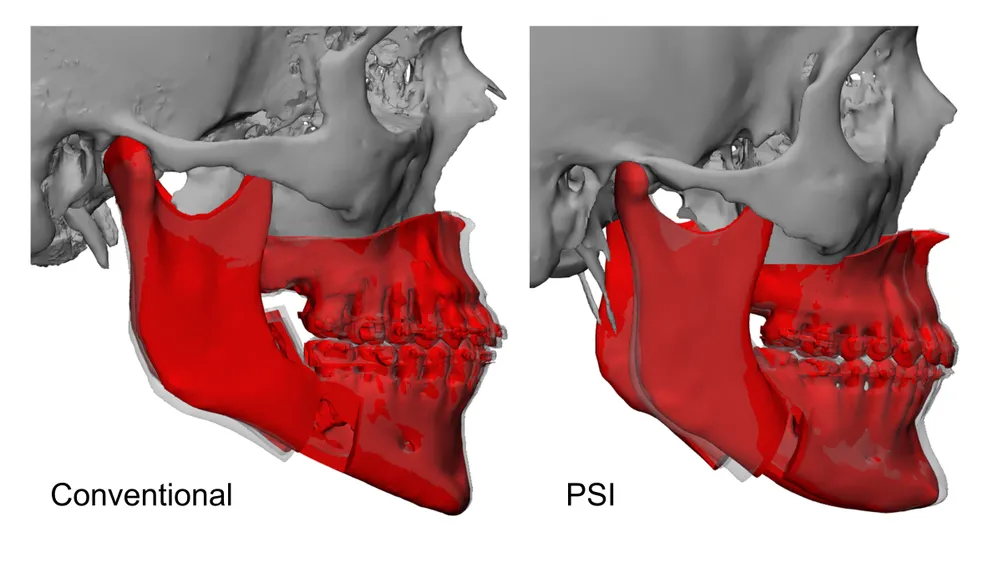
Purpose: The purpose was to compare the accuracy of maxillary and mandibular bone segment posi tioning after bimaxillary advancement surgery (BA) using: i) PSI for fixation in a three-piece Le Fort I; ii) con ventional intermediate computer-aided design/computer-aided manufacturing splints with mini plates and no final splint.
Methods
Study design, setting, sample: Adults with Class II occlusion indicating BA entailing three-piece Le Fort I were recruited in 2023-2025 at the Department of Oral and Maxillofacial Surgery, University Hospital of Southern Denmark, Esbjerg. Subjects diagnosed with cleft lip, craniofacial syndromes, former trauma, bone diseases, obstructive sleep apnea, and reoperation were excluded.
Predictor variable: The predictor variable was fixation technique, and subjects were randomly allo cated into PSI or conventional fixation.
Main outcome variables: The main outcome variable was accuracy, determined by measuring linear deviation (mm) of the maxillary central segment and transversal deviation (mm) of maxillary lateral seg ments. Outcomes <2 mm were classified as accurate.
Covariates: The covariates were age, sex, linear movement of the central maxillary segment, transversal movement of lateral maxillary segments, linear movement, and pitch of the distal mandibular segment.
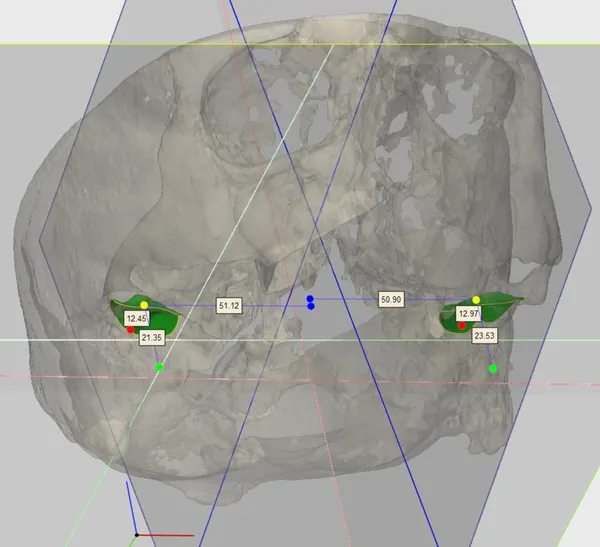
Analysis: A standardized accuracy measurement method (FAST3D) was applied on preoperative and postoperative cone-beam computed tomography. Median and interquartile range (IQR) summarized the data. A Mann-Whitney U test determined differences in deviations between groups.
Results
56 subjects (29 PSI, 52%, 25 male (44%), mean age 27 (9.36)) were analyzed. The PSI was statisti cally significantly more accurate in transversal repositioning of lateral maxillary segments (PSI: 1.63 mm, IQR: 0.84 to 2.57; conventional: 2.41 mm, IQR: 1.29 to 3.93; P = .04). However, neither group was significantly <2 mm deviation threshold (P > .08). No statistically significant difference in maxillary central segment devi ation was observed. Statistically significant differences were observed in the distal mandibular segment advancement (PSI: 2.24 mm, IQR: 1.88 to 3.02; conventional: 1.26 mm, IQR: 0.42 to 2.02; P < .01).
Conclusion
Maxillary PSI usage is more accurate in transversal repositioning of lateral maxillary seg ments, but less accurate in mandibular advancement. Nonetheless, transversal displacement of the molars was inaccurate with both methods.