Effect of quantum iterative reconstruction on coronary stent assessment in ultra-high resolution photon-counting detector CT: a phantom study
Authors
- Scheuer ST, Kusk MW, Sæderup H, Grumsen L, Diaconu A, Arnoldson HP, Jensen LO, Holte MB, Sand NPR, Madsen KT
 Søren Thorup Scheuer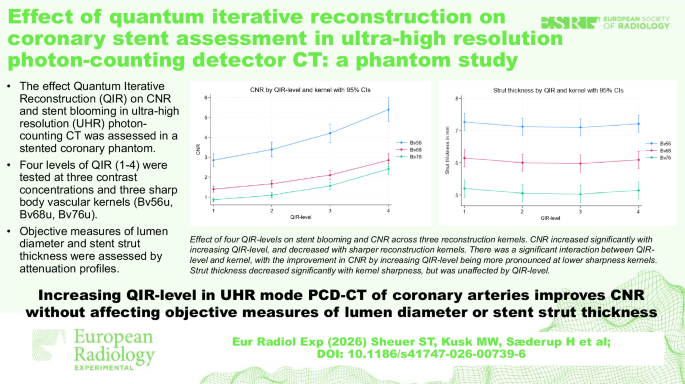
Abstract
Objectives
This study seeks to assess the impact of quantum iterative reconstruction (QIR) on objective measures of contrast-to-noise ratio (CNR), lumen diameter, and stent strut thickness using photon-counting detector computed tomography (PCD-CT) in ultra-high resolution mode (UHR) in a coronary phantom.
Methods
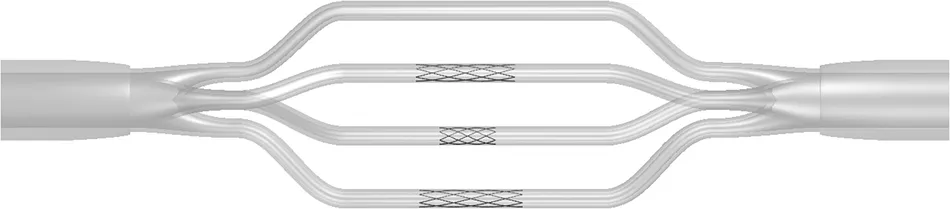
A three-dimensional printed phantom (four parallel vessels; 3 vessels with varying 3.5-mm stent types) was applied. Demineralized water, mixed with iodinated contrast, was circulated through the phantom by a dynamic pump. Images were acquired on a commercially available PCD-CT system using retrospective helical acquisition in UHR mode at both 120 and 140 kVp. Images were reconstructed at four QIR-levels (1‒4) using three sharp vascular kernels (Bv56u, Bv68u, and Bv76u). Quantitative evaluations of lumen diameter (mm) and stent strut thickness (mm) were assessed by attenuation profiles using an in-house MATLAB script.
Results
Increasing QIR level from 1 to 4 improved CNR from 1.5 (95% confidence interval [CI] 1.31‒1.70) (QIR-level 1) to 3.33 (95% CI: 2.89‒3.77) (QIR-level 4), p < 0.001. There was no change (QIR-level 1 to 4) in lumen diameter, range 2.95 mm (95% CI: 2.89‒3.02) to 2.97 mm (95% CI: 2.91‒3.03) (p = 0.890) or strut thickness, range 0.62 mm (95% CI: 0.59‒0.65) to 0.61 mm (95% CI: 0.58‒0.65 ((p = 0.870), regardless of contrast concentration or reconstruction kernel.
Conclusion
Increasing QIR-level in UHR mode PCD-CT in a stented coronary phantom improved CNR without affecting objective measures of lumen diameter or stent strut thickness under controlled phantom conditions.
There has been debate regarding the negative impact of iterative reconstruction on spatial resolution, potentially increasing blooming artifacts caused by coronary stents, which is of special concern when imaging small stent lumens. Currently, no studies have assessed the effect of QIR on the objective assessment of coronary stents.